
A radiator that stays cold or only warms at the bottom usually points to trapped air, poor system balance, or a boiler issue. Air pockets block hot water flow and often leave the top 30–50% of the panel cool. Imbalanced systems can send most heat to radiators closest to the boiler, leaving distant rooms under-heated. Boiler faults such as low pressure (often below 1.0 bar) or a failing pump can also reduce circulation and heat output.
Key takeaways
- Bleed trapped air using a radiator key until water runs steadily.
- Cold at the top and warm at the bottom usually indicates air in the radiator.
- Cold at the bottom often points to sludge; flushing may restore heat.
- Balance the system by adjusting lockshield valves so all radiators heat evenly.
- Check boiler pressure; low pressure can stop radiators reaching temperature.
- A stuck thermostatic radiator valve pin can prevent hot water entering the radiator.
Confirm the Symptoms: Cold Radiator, Cold Spots, or No Heat Across the System
In the UK, space and water heating accounts for about 80% of typical household energy use (Department for Energy Security and Net Zero). That share means a single radiator fault can signal a wider efficiency problem, not just comfort. Confirm what you can observe, because each symptom points to a different cause.
If one radiator stays cold while others heat normally, the issue often sits at the radiator or its valves, not the boiler. If the radiator feels warm at the bottom but cold at the top, trapped air commonly blocks circulation; bleeding often restores heat within 2–5 minutes per radiator. If cold patches appear across the panel, sludge can restrict flow; magnetite build-up can cut heat transfer and raise boiler cycling, with flow temperatures often set around 60–75°C.
If every radiator stays cold, check whether the boiler pressure sits in the typical 1.0–1.5 bar range when cold; readings below 0.5 bar can stop circulation. Note whether the hot water still works, since that split helps separate boiler-side faults from heating-side issues.
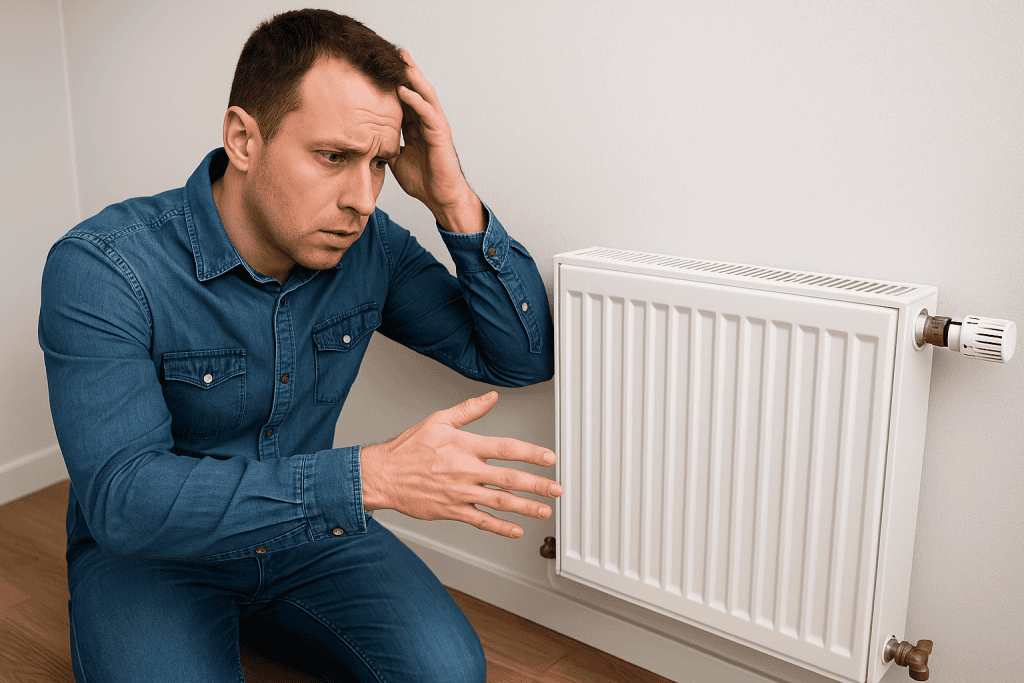
Radiator Not Heating Up?
Bleeding the Radiator: Trapped Air, Correct Tools, and Safe Pressure Checks
On a February morning, the living room radiator stays cold at the top while the bottom turns warm. That pattern usually points to trapped air, which blocks hot water from filling the upper channels and reduces heat output.
Bleeding releases that air through the bleed valve at the radiator’s top corner. Use a radiator key (typically a 5 mm square) or a flat-blade screwdriver on slotted valves, and hold a cloth under the vent. Turn the valve a quarter-turn anti-clockwise until air hisses out, then close it as soon as a steady stream of water appears. Most radiators release air within 10–30 seconds; longer venting can indicate repeated air ingress from the system.
Check boiler pressure straight after bleeding. Most UK sealed systems run best around 1.0–1.5 bar when cold, and bleeding can drop pressure by 0.1–0.3 bar per radiator. If the gauge falls below the boiler’s minimum (often near 0.5–0.8 bar), top up via the filling loop following the manufacturer instructions, then recheck for leaks at the bleed point and valves.
- Switch heating off and let radiators cool for 15–30 minutes to reduce scald risk.
- Bleed the highest radiators first; air rises and collects upstairs.
- If pressure keeps falling or air returns weekly, arrange a professional check for leaks or a failing expansion vessel.
Balancing Radiators: Lockshield Valve Adjustments to Fix Uneven Heating
Bleeding releases trapped air from one radiator, while balancing corrects water flow across all radiators. If one radiator heats fully and another stays lukewarm, adjusting the lockshield valve usually fixes the issue better than repeated venting.
Balancing uses the lockshield (the capped valve opposite the thermostatic radiator valve) to restrict fast-heating radiators and push hot water towards slower ones. Aim for a 10–12 °C drop between flow and return pipes on each radiator, checked with clip-on pipe thermometers.
| Option | What you change | Best fit | Practical implication |
|---|---|---|---|
| A: Balance radiators | Lockshield valve opening (quarter-turn steps) | Some radiators heat too quickly, others lag | Improves room-to-room consistency without raising boiler temperature |
| B: Increase boiler output | Flow temperature or heating curve | Whole house underheats in cold weather | Can increase gas use if flow is already adequate |
| C: Check circulation | Pump speed, valves, sludge risk | Several radiators stay cool despite balancing | May need checks beyond radiator valves |
After each adjustment, wait 10–15 minutes for temperatures to stabilise before measuring again. If system pressure drops below the boiler’s normal range, restore it using the manufacturer’s filling loop guidance, or review Complete Guide to Boiler and Plumbing.
Boiler and System Causes: Pump Issues, Diverter Valve Faults, Sludge, and Low System Pressure
If several radiators stay cold or only warm at the bottom, the fault often sits at the boiler or primary circuit, not the emitter. Low system pressure provides a clear clue: most UK combi boilers run best at about 1.0–1.5 bar when cold, and many lock out below roughly 0.5 bar (check the boiler gauge). Circulation faults can also show as a hot flow pipe leaving the boiler but a cool return, which suggests a seized pump, a stuck diverter valve, or sludge restricting flow.
Restore pressure to the manufacturer’s range using the filling loop, then run heating and recheck the gauge after 10 minutes. If pressure rises towards 2.5–3.0 bar when hot, the expansion vessel may need attention. Listen for pump noise and feel for vibration at the housing; silence with a calling thermostat can indicate a stalled motor. If hot water works but radiators do not, a diverter valve may not switch fully to heating.
After correction, radiators should heat evenly within 15–30 minutes, and the return pipe should warm steadily. For system-wide contamination and maintenance steps, use Complete Guide to Boiler and Plumbing.
Frequently Asked Questions
How can you tell whether trapped air is stopping a radiator from heating up?
Trapped air usually leaves the radiator hot at the bottom but cool at the top, even when the heating runs for 10–15 minutes. You may also hear gurgling or bubbling from the radiator or pipes. Boiler pressure often drops below 1.0 bar on sealed systems, and the radiator may stay lukewarm despite the valve being fully open.
What step-by-step method should you use to bleed a radiator safely without losing too much system pressure?
Turn heating off and let radiators cool (15–30 minutes). Place a cloth and container under the bleed valve. Open the valve a quarter-turn with a radiator key until air hisses. When a steady water stream appears, close firmly. Check boiler pressure; top up to 1.0–1.5 bar if needed. Repeat on higher radiators.
How do you balance radiators to fix a system where some radiators heat up and others stay cold?
Turn heating on and open all radiator valves. Start with the radiator closest to the boiler: fully open the lockshield valve, then move to the next. For each radiator, close the lockshield, then reopen 1/4–1/2 turn until the return pipe reaches about 50–60°C and warms 10–12 minutes after the flow pipe. Repeat outward.
Which boiler pressure readings indicate a problem when radiators do not heat up properly?
Most sealed systems run at 1.0–1.5 bar when cold and about 1.5–2.0 bar when hot. Readings below 0.8 bar often cause poor circulation, leaving radiators cool. Pressure above 2.5 bar (or approaching the 3.0 bar safety limit) indicates overfilling or expansion vessel faults and can trigger boiler lockouts.
What boiler or central heating faults can cause a radiator to stay cold even after bleeding and balancing?
If bleeding and balancing do not help, faults often sit at the boiler or system level. Common causes include:
- Low system pressure (typically below 1.0 bar cold), limiting circulation.
- Circulation pump failure or incorrect speed setting, reducing flow to distant radiators.
- Diverter valve sticking on combi boilers, sending heat to hot water instead of heating.
- Blocked heat exchanger or system sludge restricting flow, often affecting one circuit.