This complete guide to boiler and plumbing explains how domestic heating and water systems work, what typically fails, and how to respond safely. A modern condensing boiler can reach 90–94% seasonal efficiency, while older non-condensing models often run closer to 70–80%. UK households use about 142 litres of water per person per day, so small leaks can waste thousands of litres each month. You will also learn when to carry out basic checks and when to call a qualified engineer.
Key takeaways
- Choose boiler type by property size, hot-water demand, and existing pipework layout.
- Annual boiler servicing reduces breakdown risk and maintains safe combustion performance.
- Bleeding radiators and balancing the system improves heat distribution and cuts cold spots.
- Low boiler pressure often indicates leaks; repressurise only after checking visible joints.
- Hard-water areas benefit from scale control to protect heat exchangers and valves.
- Common plumbing faults include dripping taps, running toilets, and blocked waste pipes.
- Use qualified engineers for gas work and complex repairs to meet safety standards.
Boiler and Plumbing Systems Explained: Components, Pipework, and Water Flow
In 2024, UK homes used 72% of their total energy for space heating and hot water (Department for Energy Security and Net Zero, DESNZ). That share explains why boiler and plumbing design has an outsized impact on comfort, running costs, and reliability. A typical domestic boiler transfers heat through a primary circuit, while the plumbing system distributes hot and cold water through separate pipework sized to maintain stable pressure and flow.
Most modern gas boilers operate as condensing units, which can reach up to 92% seasonal efficiency under the UK ErP framework (UK Government, Energy-related products (ErP)). Condensing performance depends on returning cooler water to the heat exchanger, often around 55°C or lower, so the system can recover latent heat from flue gases. As a result, radiator balancing, correct pump speed, and appropriately sized pipe runs directly affect efficiency.
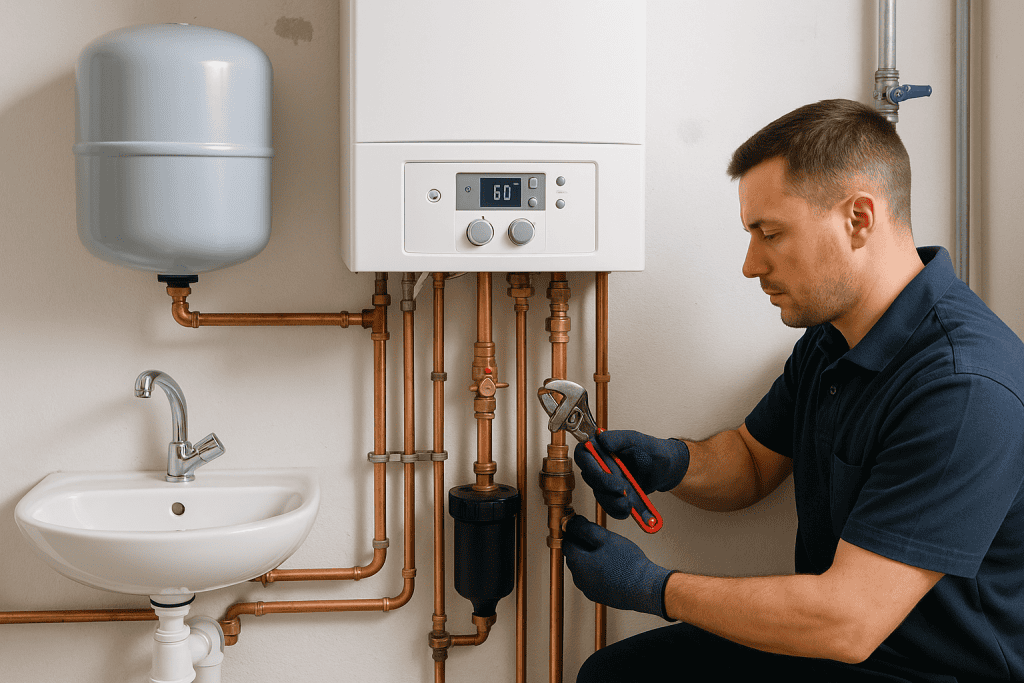
Water flow follows pressure differentials created by pumps and mains supply. UK water companies typically deliver 1–2 bar at the boundary stop tap, while sealed heating circuits often run near 1.0–1.5 bar when cold to protect the pump and prevent air ingress. Key components include the heat exchanger, circulating pump, expansion vessel, pressure relief valve, and motorised valves, each controlling temperature, safety limits, and direction of flow between radiators and hot-water cylinders.
Boiler Types Compared: Combi, System, and Regular Boilers for UK Homes
A two-bathroom semi-detached home in Manchester replaces a 20-year-old boiler after repeated pressure drops and slow hot water at the shower. The installer finds no hot water cylinder and limited airing-cupboard space, so the household chooses a 30 kW combi boiler. Hot water improves, but running a bath can reduce shower flow because the boiler meets demand in real time.
The key difference between boiler types is hot water storage and peak-demand handling. A combi boiler heats water on demand and removes the need for a cylinder, which suits smaller homes and flats. A system boiler uses a hot water cylinder for steadier supply to multiple outlets, with most components inside the casing. A regular boiler (conventional) also uses a cylinder plus a cold-water storage tank, which often suits older pipework.
- Combi: best where space is tight; typical outputs range from 24–40 kW for UK homes.
- System: steadier hot water for 2+ bathrooms; cylinder size often sits around 150–250 litres.
- Regular: suits low mains pressure and legacy systems; usually needs a loft tank plus cylinder.
Match boiler type to bathrooms, mains pressure, and storage space, then confirm efficiency and controls. Since 2018, UK boiler installations have typically required a minimum ErP efficiency of 92% for gas boilers (UK Government Boiler Plus), so configuration often matters more than headline efficiency.
Boiler Installation Essentials: Sizing, Location, Flueing, and Condensate Drainage
A correctly sized boiler delivers stable temperatures; an oversized boiler short-cycles, wasting gas and stressing components. UK installers size output to property heat loss and hot-water demand, then confirm the result during commissioning. Modern condensing boilers can reach up to 94% seasonal efficiency under the UK SEDBUK method, but only when low return temperatures support condensing.
Location creates a trade-off: an internal utility space reduces frost risk and can shorten condensate runs, while a loft or garage installation may simplify flue routing but can increase access and insulation requirements. Flueing choices often compare a short, straight horizontal flue against a longer route with bends; each bend increases resistance and can reduce the maximum permitted flue length under the manufacturer’s instructions. Installers must follow Gas Safe Register requirements and the boiler manual for terminal clearances and plume management.
| Installation factor | Option A | Option B | Practical implication |
|---|---|---|---|
| Sizing | Matched to heat loss | Oversized “to be safe” | Reduces cycling and improves comfort consistency |
| Flue route | Short, straight run | Longer run with bends | May constrain siting and require manufacturer-specific limits |
| Condensate drainage | Internal 32 mm pipe | External run | External sections raise freezing risk; internal routing improves reliability |
Condensate drainage often determines winter reliability. UK Government guidance recommends minimising external pipework and using a larger diameter where external runs cannot be avoided, because frozen condensate remains a leading cause of boiler lockouts during cold snaps.
Plumbing Pipework and Materials: Copper, Plastic, Fittings, and Best Practice
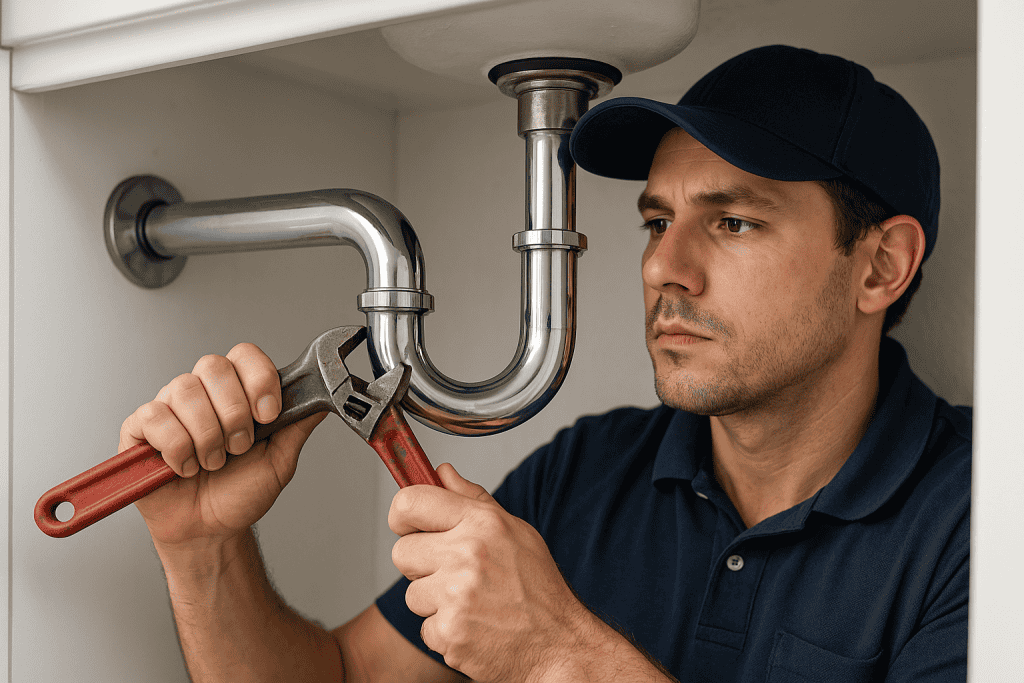
Leaks and low flow often trace back to poor pipe sizing or incompatible materials. A 1 mm pinhole in copper can waste roughly 15–20 litres per hour at typical mains pressure, while a single 90° elbow can add the equivalent resistance of about 0.5–1.0 m of straight pipe in small diameters, reducing shower performance.
Match materials to temperature, pressure, and access. Copper suits high temperatures and exposed runs; plastic barrier pipe (PEX or polybutylene) installs faster and reduces joints, but needs inserts and correct support spacing to prevent sagging. Use WRAS-approved components to protect potable water quality (WRAS).
- Plan routes: minimise fittings; keep hot and cold runs separate.
- Size correctly: use 15 mm for short branches; step up to 22 mm on longer runs or multiple outlets.
- Make joints properly: deburr copper, use flux sparingly, and pressure-test before boxing in.
- Protect pipework: insulate hot pipes and runs in unheated voids; fit isolation valves at key branches.
These steps cut leak risk, stabilise tap flow, and reduce heat loss, improving comfort and lowering wasted energy.
Heating Controls and Efficiency: Thermostats, TRVs, Zoning, and Boiler Modulation
Smart heating controls can cut space-heating energy use by up to 16.5% when a boiler uses load compensation, compared with a system without that feature (UK DESNZ). That reduction matters because space heating drives most winter gas demand, and small control improvements compound across a full heating season. Controls also reduce temperature swings, which improves comfort and helps condensing boilers stay in their most efficient operating range.
A room thermostat sets the target air temperature, while thermostatic radiator valves (TRVs) limit heat output room by room. In practice, TRVs help prevent overheating in sunny rooms or bedrooms, which can trim fuel use without changing the whole-house setpoint. For example, dropping the main thermostat by 1 °C typically reduces heating energy by about 10%, a widely used rule of thumb in UK energy advice (Energy Saving Trust: energysavingtrust.org.uk). Pairing that change with TRVs often makes the lower setpoint feel less noticeable because frequently used rooms can still reach their preferred temperature.
Zoning extends this idea by splitting the home into separate heating circuits, each with its own schedule and sensor. A two-zone layout (living areas and bedrooms) can reduce wasted heat during working hours, particularly in larger properties with 10+ radiators. Boiler modulation then matches burner output to demand; a modern modulating boiler can turn down to roughly 20–30% of its maximum output, which reduces cycling and keeps return temperatures lower for longer. When return temperatures stay below about 55 °C, a condensing boiler can recover more latent heat from flue gases, improving seasonal efficiency and reducing running costs.
Routine Maintenance and Servicing: Annual Checks, Water Quality, and System Pressure
A homeowner in Leeds notices the boiler pressure has fallen from 1.3 bar to 0.7 bar and one radiator stays cold at the top. After topping up, the pressure climbs to 2.2 bar when the heating runs, then the relief pipe outside drips. A Gas Safe engineer finds a partially failed expansion vessel and air trapped in the system, both common outcomes when annual servicing slips.
An annual check typically includes a combustion analysis, safety inspection, and a review of seals and condensate drainage. In the UK, a correctly operating sealed system usually sits around 1.0–1.5 bar when cold and rises by roughly 0.3–0.5 bar when hot; larger swings often point to expansion or filling-loop issues. Water quality also drives reliability: sludge and magnetite restrict flow, while limescale forms faster in hard-water areas, reducing heat transfer.
Apply the same discipline across the system: keep pressure stable, bleed radiators when needed, and ask for inhibitor levels and a magnetic filter check during service. Use a registered engineer via Gas Safe Register and follow servicing intervals set by the boiler manufacturer.
Troubleshooting Common Faults: No Heat, No Hot Water, Leaks, and Low Pressure
Boiler failures usually present as a total loss of service (no heat or no hot water) or a partial fault (leaks or low pressure). Total loss often points to controls, ignition, or a safety lockout, while partial faults more often involve water loss, air ingress, or a failing component such as an expansion vessel.
| Fault | Option A: Likely cause | Option B: Likely cause | Practical implication |
|---|---|---|---|
| No heat, hot water OK | Programmer/thermostat not calling for heat | Motorised valve or pump not circulating | Check schedule and setpoint; if radiators stay cold after 10–15 minutes, arrange an engineer visit. |
| No hot water, heating OK | Combi: flow sensor or diverter valve fault | Stored hot water: cylinder thermostat or valve fault | Hot taps run cold after 30–60 seconds; avoid repeated resets, which can mask an intermittent fault. |
| Visible leak | Pipework joint or radiator valve seepage | Boiler internal leak (condensate trap, heat exchanger) | Even a 1 mm pinhole can waste about 15–20 litres per hour; isolate water if dripping continues. |
| Low pressure | System leak or recent bleeding | Expansion vessel losing charge | Most sealed systems run at about 1.0–1.5 bar when cold; repeated drops below 0.8 bar need investigation. |
Only a Gas Safe Register engineer should open a gas boiler case. If pressure exceeds 3.0 bar or the external relief pipe discharges, stop topping up and book a repair, as over-pressurisation can damage valves and seals.
Safety, Compliance, and When to Call a Professional: Gas Safe, Building Regulations, and Warning Signs
Unsafe gas work causes measurable harm: the UK recorded 26 carbon monoxide (CO) deaths in England and Wales in 2023 (ONS). Separately, Gas Safe Register investigated 3,105 reports of illegal gas work in 2023/24, a common trigger for unsafe installations and poor combustion (Gas Safe Register).
Use a simple rule: treat any work on gas appliances, flues, or pipework as professional-only. For compliance, follow Approved Document J (combustion appliances and flues) and Approved Document G (hot water safety), which set minimum requirements for ventilation, flueing, and discharge from safety valves.
- Before booking: check the engineer’s licence on Gas Safe Register and confirm the appliance category (boilers, cookers, fires).
- During the visit: request a commissioning checklist and ask where the flue terminal and condensate route comply with manufacturer clearances.
- After completion: obtain the Building Regulations compliance certificate (usually issued within 2–6 weeks) and keep the benchmark logbook.
Call a professional immediately if you smell gas, see sooting around the boiler, notice yellow/orange flames, hear repeated ignition attempts, or feel persistent headaches with nausea (possible CO). Correctly installed and certified work reduces leak risk, supports valid warranties, and protects resale documentation.
Frequently Asked Questions
What are the most common warning signs that a boiler needs professional repair?
Common boiler repair warning signs include loss of heat or hot water, pressure below 1 bar or above 2.5 bar, and repeated lockouts. Watch for unusual noises (kettling, banging, whistling), leaks or corrosion, a yellow or flickering pilot flame, and rising gas bills. Any burning smell or carbon monoxide alarm requires immediate professional attention.
How often should a boiler be serviced in the UK to meet safety and warranty requirements?
Service a boiler every 12 months in the UK. An annual check by a Gas Safe registered engineer meets typical manufacturer warranty terms and supports safe operation. Landlords must arrange a gas safety check at least every 12 months and provide a valid Gas Safety Record. Missing annual servicing can void warranties and increase breakdown risk.
What causes low boiler pressure, and how can it be safely corrected?
Low boiler pressure usually comes from a leak (even a slow radiator valve drip), recently bled radiators, or a faulty pressure relief valve. Most sealed systems run at 1.0–1.5 bar when cold; below 0.5 bar often triggers a lockout. To correct, top up via the filling loop to about 1.2 bar, then close both valves. If pressure drops again, call a Gas Safe engineer.
How can a homeowner identify and isolate a hidden water leak in domestic plumbing?
Check the water meter: record the reading, avoid water use for 60 minutes, then recheck. A rise indicates a leak. Isolate by closing the internal stopcock; if the meter still moves, suspect the supply pipe. If it stops, reopen and shut off appliances and zone valves one at a time to locate the circuit.
When should a boiler be replaced instead of repaired, based on age, efficiency, and repair costs?
Replace a boiler when it is over 15 years old, runs below 85% efficiency (common for non-condensing models), or needs frequent repairs. Consider replacement if a single repair exceeds £500 or if annual repairs total more than 50% of a new boiler’s installed cost. Replace immediately for a cracked heat exchanger or unsafe combustion.