Heating controls have changed from simple dials and timers to connected smart thermostats with app control and automation. Each option promises comfort and efficiency, yet the best choice depends on how a home is used, how the boiler responds, and how much control is needed day to day.
This comparison explains how smart thermostats and old school controllers differ in features, running costs, ease of use, and reliability. It also highlights where each system performs best, so you can match the control type to your household and heating habits.
Key takeaways
- Smart thermostats learn routines and adjust heating automatically to reduce wasted energy.
- Old school controllers rely on manual schedules, which often stay unchanged for months.
- App control and remote access help manage heating when plans change unexpectedly.
- Geofencing can lower heating when the home is empty and restore comfort on return.
- Smart models provide usage reports that highlight patterns and support targeted savings.
- Installation and compatibility depend on wiring, boiler type, and existing heating controls.
How Smart Thermostats and Traditional Controllers Work
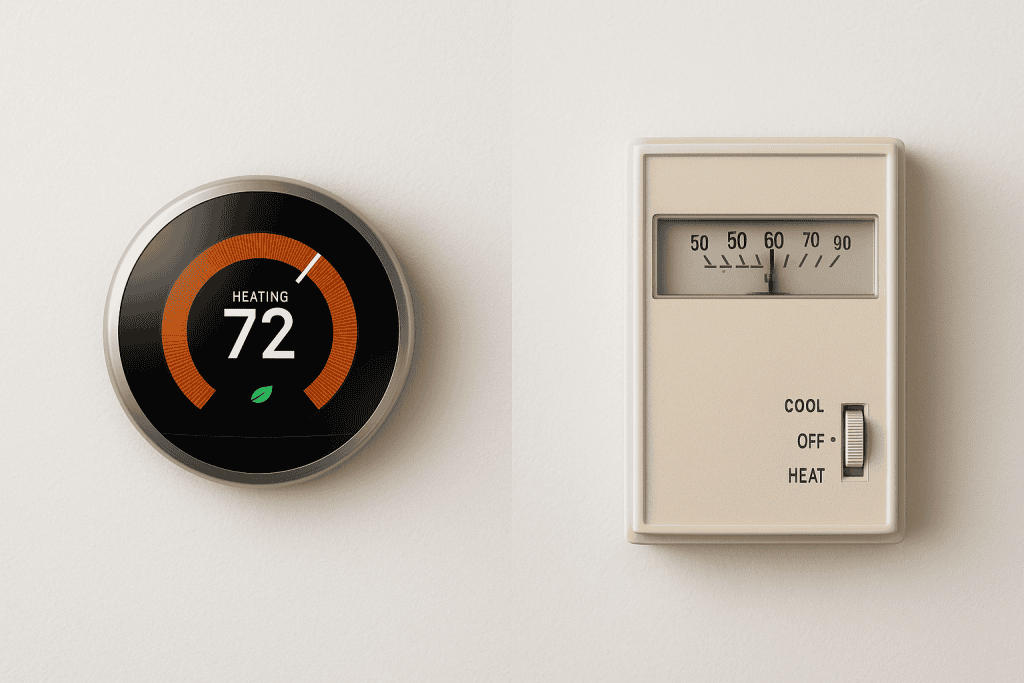
Traditional heating controllers regulate temperature through a fixed schedule and a simple sensor, often located inside the controller. A user sets time blocks and target temperatures, then the controller switches the boiler on or off to follow that plan. Many systems use basic “on/off” control, which calls for heat at full output until the room reaches the set point, then stops. Some setups use a wired room thermostat and a separate programmer, which can limit flexibility if household routines change.
Smart thermostats keep the same core job, yet they add networked control, richer sensing, and automation. A smart thermostat connects to a home Wi‑Fi network and a companion app, which lets a user adjust heating remotely and set more granular schedules. Devices such as the Hive thermostat or tado° can use multiple data points, including temperature readings from the device and, in some systems, optional room sensors. Many models also support “geofencing”, which uses a phone’s location to reduce heating when the home is empty and restore comfort before occupants return.
Control methods also differ. Several smart thermostats use modulation when paired with compatible boilers, which adjusts heat output in smaller steps rather than cycling fully on and off. That approach can improve comfort and reduce short cycling, although results depend on the boiler and the control protocol. Guidance from the Energy Saving Trust highlights that effective controls help match heat delivery to demand, which can cut waste. Even so, smart features only deliver value when settings reflect real routines and the system remains correctly configured.
Energy Efficiency, Running Costs, and Carbon Impact Compared
Energy use depends less on the boiler label and more on how accurately the controls match heat output to demand. Traditional controllers can run efficiently when a household follows a consistent routine. However, fixed schedules often heat empty rooms, while manual overrides tend to leave higher set points in place for longer than intended. Smart thermostats usually reduce this waste through occupancy sensing, adaptive scheduling, and tighter temperature control, which can cut the number of unnecessary heating cycles.
Running costs follow the same pattern. When a smart thermostat trims heating hours or lowers set points during low-use periods, gas or electricity consumption falls. Savings vary with insulation, tariff, and lifestyle, so no single figure suits every home. Even so, independent guidance from the UK Government’s energy advice supports the principle that better control reduces demand. Smart systems also help users spot patterns through usage reports, which can prompt practical changes such as shorter morning boosts or lower night temperatures.
Carbon impact links directly to fuel use. For gas boilers, fewer burner hours usually mean lower emissions. For heat pumps, smarter control can reduce peak demand and improve efficiency by avoiding sharp temperature jumps. A smart thermostat can also support time-of-use behaviour, such as pre-heating when electricity carries a lower carbon intensity, where tariffs and heating systems allow.
That said, traditional controllers can compete in simple homes with predictable occupancy, especially when users keep schedules tight and avoid frequent overrides. Smart thermostats deliver the strongest gains in households with irregular routines, multiple occupants, or a tendency to forget adjustments. Products such as Hive, tado°, and Google Nest often add room-by-room options and automation, which can improve comfort while keeping energy use in check.
Comfort, Control Features, and Day-to-Day Usability
Comfort depends on how steadily a system holds temperature and how easily a household can adjust it. Traditional controllers often feel predictable, yet many models offer limited feedback beyond a dial or basic display. As a result, people tend to change settings in larger steps, which can lead to rooms feeling too warm or too cool for longer than necessary. Smart thermostats usually provide clearer temperature read-outs and finer adjustments, so small changes feel easier and more precise.
Control features also differ in practical ways. Many smart thermostats support remote changes through an app, which suits households with variable routines. That capability helps when plans change, such as returning home earlier than expected. Some systems also allow room-by-room control when paired with smart radiator valves, which can improve comfort in homes where bedrooms, living areas, and home offices need different temperatures. For example, tado° and Hive offer app-based scheduling and multi-room options, while Google Nest focuses on learning routines and simple automation.
Day-to-day usability often decides which approach “wins”. A traditional controller can suit people who prefer a set-and-forget routine and do not want to rely on Wi‑Fi or phone access. Smart thermostats, however, tend to reduce friction for common tasks such as temporary boosts, holiday settings, and checking whether the heating is on. That said, app menus, notifications, and account logins can frustrate users who want a single physical control. A good compromise involves choosing a smart model with a clear wall unit and straightforward manual override, so comfort stays accessible even when the phone is not.
Installation, Compatibility, Data Privacy, and Long-Term Value
Installation often decides which option suits a property. Many traditional controllers use simple wiring and a standard backplate, so a like-for-like swap can take little time. Smart thermostats vary. Some models replace only the wall unit, while others add a wireless receiver at the boiler and, in some cases, radiator valves. A qualified installer can confirm safe wiring, correct boiler connections, and suitable placement for accurate temperature readings.
Compatibility needs careful checking before purchase. Boiler type, control method, and existing wiring all matter, including support for modulation (the ability to vary heat output rather than switching fully on or off). Some smart systems work best with specific boiler interfaces, while others rely on basic relay control. Manufacturer compatibility tools help, such as the checker from Hive or product guidance from tado°. When a home uses multiple heating zones, underfloor heating, or a hot water cylinder, the control requirements become more complex, so model choice matters.
Data privacy also deserves attention because smart thermostats connect to home Wi‑Fi and cloud services. A buyer should review what data a provider collects, how long a provider keeps that data, and whether a user can delete it. Clear privacy documentation and strong account security reduce risk. For UK households, the Information Commissioner’s Office (ICO) explains key rights and expectations under data protection law.
Long-term value goes beyond energy savings. Smart thermostats can add ongoing costs through subscriptions, paid features, or replacement batteries for wireless sensors. Traditional controllers tend to cost less to maintain, yet they may limit future upgrades. A practical approach compares total cost over five to ten years, including installation, optional add-ons, and the likelihood of moving home, where a new occupant may not value app-based control.
Frequently Asked Questions
What key features set smart thermostats apart from traditional heating controllers?
Smart thermostats add app control, remote access, learning schedules, geofencing (adjusting heat by phone location), and energy reports. Many support voice assistants and integrate with other smart home devices. Traditional controllers usually offer manual timers and fixed temperature settings, with limited automation and no real-time monitoring.
How much can a smart thermostat reduce heating costs compared with an old school controller?
A smart thermostat can cut heating costs by about 8% to 15% compared with an old school controller, mainly through better scheduling, automatic setbacks, and reduced overheating. Savings vary with insulation, boiler efficiency, energy prices, and how consistently occupants follow a heating plan.
Do smart thermostats work with combi boilers, system boilers, and heat pumps?
Yes, many smart thermostats work with combi boilers and system boilers, provided the thermostat supports the boiler’s control type (on/off or OpenTherm). Heat pumps often need a thermostat designed for low-temperature, modulating control and weather compensation. Always check the boiler or heat pump wiring, voltage, and compatibility list before purchase.
What installation requirements apply to smart thermostats versus traditional controllers?
Smart thermostats often need a compatible boiler or heat pump, a stable Wi-Fi connection, and a suitable power supply (battery or mains). Many also require a wiring check for common terminals and may need a professional installer. Traditional controllers usually use simple on/off wiring, need no internet, and suit most existing systems.
How reliable are smart thermostats if Wi‑Fi fails or a power cut occurs?
Most smart thermostats keep basic heating control during Wi‑Fi outages because the schedule and temperature settings store locally. Remote app control, voice assistants, and cloud features stop until the connection returns. During a power cut, mains-powered units switch off; battery-backed models may keep settings but cannot run the boiler without power.
What privacy and data security risks come with smart thermostats, and how can households reduce them?
Smart thermostats can expose occupancy patterns, location data and Wi-Fi credentials through weak passwords, insecure apps or unpatched firmware. Reduce risk by using unique strong passwords, enabling two-factor authentication, updating firmware, limiting permissions, disabling unnecessary data sharing, segmenting devices on a guest network, and choosing reputable brands with clear privacy policies.
Which option suits households with irregular schedules: a smart thermostat or an old school controller?
Households with irregular schedules usually suit a smart thermostat. It can learn patterns, use occupancy sensors or geofencing, and adjust heating automatically to reduce waste while maintaining comfort. An old school controller relies on fixed timers, so it often heats an empty home or leaves rooms cold when plans change.