
Gas boilers heat millions of UK homes, but faulty combustion can release carbon monoxide (CO), an odourless gas that can kill within hours. In England, the NHS reports around 4,000 hospital attendances each year from accidental CO poisoning, with roughly 30 deaths annually. This guide explains how CO forms in boilers, the most common warning signs such as headaches and nausea, and how certified CO alarms reduce risk through early detection.
Key takeaways
- Carbon monoxide from faulty gas boilers can cause serious illness without any smell.
- Early warning signs include headaches, dizziness, nausea, breathlessness, and confusion indoors.
- Symptoms often improve outdoors and worsen when the boiler runs.
- Yellow or lazy flames, soot marks, and excess condensation can indicate incomplete combustion.
- Install an audible carbon monoxide alarm near the boiler, following manufacturer placement guidance.
- Test alarms regularly, replace batteries promptly, and renew units at end-of-life dates.
- Arrange annual boiler servicing by a Gas Safe registered engineer to reduce risk.
How Carbon Monoxide Forms in Gas Boilers and Why It Becomes Dangerous Indoors
Carbon monoxide (CO) caused 69 deaths in England and Wales in 2022, according to the Office for National Statistics. That figure captures only confirmed fatalities; non-fatal poisonings often go unrecorded because symptoms mimic flu or fatigue. Gas boilers can generate CO whenever combustion becomes incomplete, and indoor conditions can allow dangerous concentrations to build quickly.
A modern boiler should burn natural gas with enough oxygen to produce mainly carbon dioxide and water vapour. When the burner receives too little air, or the flame becomes unstable, the appliance produces higher CO levels. Common triggers include a partially blocked flue, poor ventilation, incorrect gas-to-air ratio, or a damaged heat exchanger that disrupts the flame pattern. Even small changes in airflow can shift combustion chemistry, which is why servicing and correct installation matter.
CO becomes dangerous indoors because it displaces oxygen in the bloodstream. The US Centers for Disease Control and Prevention notes that CO binds to haemoglobin about 200–250 times more strongly than oxygen, reducing oxygen delivery to the brain and heart. At 400 parts per million (ppm), CO can cause headache and nausea within 1–2 hours; at 800 ppm, collapse can occur within 45 minutes (CDC). These thresholds explain why exposure in a closed room can escalate from mild symptoms to a medical emergency.
Indoor risk rises when exhaust gases cannot leave the property. A blocked terminal, a poorly sealed flue joint, or negative pressure from extractor fans can pull combustion products back inside. UK gas safety rules require competent work on gas appliances; the Health and Safety Executive sets out legal duties and guidance for safe installation and maintenance. For broader context on heating system upkeep and fault patterns, see the Complete Guide to Boiler and Plumbing.
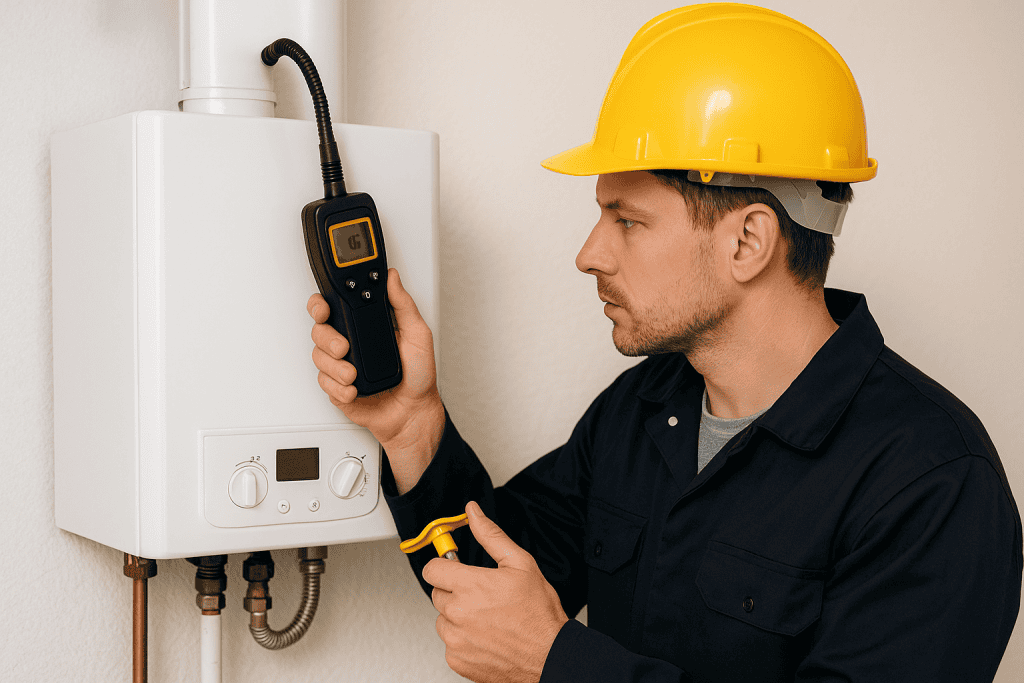
Gas Boiler Safety
Carbon Monoxide Exposure Symptoms and Home Warning Signs Linked to Boiler Faults
At 06:30 on a January morning, a household wakes with headaches and nausea. The windows stay shut against the cold, and the boiler has run overnight to maintain 20°C. By mid-morning, one adult feels unusually drowsy and struggles to concentrate, while a child complains of dizziness. The symptoms ease after a short walk outside, then return within an hour of coming back indoors. That pattern strongly suggests carbon monoxide exposure linked to a combustion or flue fault.
Carbon monoxide (CO) poisoning often starts with non-specific symptoms: headache, dizziness, nausea, breathlessness, and confusion. The NHS notes that symptoms can resemble flu but without a high temperature, which delays recognition. Exposure can escalate quickly because CO binds to haemoglobin around 200–250 times more strongly than oxygen, reducing oxygen delivery to the brain and heart. As a result, people may become sleepy, make poor decisions, or fail to react as concentrations rise.
Home warning signs linked to boiler faults usually appear before severe symptoms. Watch for sooty or yellow-brown staining around the boiler casing, flue joints, or nearby walls, and for a pilot light that burns yellow or orange rather than crisp blue. Condensation on windows can increase in winter, but persistent dampness near the boiler or flue can indicate poor ventilation or flue spillage. If multiple occupants or pets develop headaches at the same time, and the symptoms improve outdoors within 10–30 minutes, treat the situation as an emergency and seek urgent help.
Detectors provide the most reliable early warning because human senses cannot detect CO. In the UK, alarms should meet BS EN 50291 and sit in the same room as the boiler, typically 1–3 metres from the appliance, following manufacturer guidance. The Health and Safety Executive (HSE) advises using audible alarms as a back-up, not a substitute for annual servicing by a Gas Safe registered engineer. For a wider maintenance framework, see the Complete Guide to Boiler and Plumbing.
Gas Boiler Risk Factors: Flue Blockages, Poor Ventilation, and Incomplete Combustion
A gas boiler with a clear flue and adequate air supply typically vents combustion products outdoors; a boiler with a restricted flue or starved ventilation can push carbon monoxide (CO) back into living spaces. The contrast matters because CO is odourless and can accumulate without visible smoke, particularly when a property remains sealed during cold weather.
Option A is a boiler operating with an unobstructed flue and stable draught. Option B is a boiler affected by flue blockages, poor ventilation, or combustion faults that increase CO production. In UK homes, blockages often come from debris, bird nests, or damaged terminals after storms, while ventilation issues frequently follow building changes such as draught-proofing or the removal of air bricks.
| Risk factor | What changes mechanically | Typical household trigger | Practical implication |
|---|---|---|---|
| Flue blockage or poor termination | Reduced exhaust flow and unstable draught | External terminal obstructed by debris or nesting | Spillage of combustion gases indoors, especially during long heating cycles |
| Poor ventilation | Lower oxygen availability for combustion | Sealed rooms, closed vents, or altered cupboards around the boiler | Higher likelihood of incomplete combustion and CO build-up |
| Incomplete combustion | Fuel does not fully oxidise; CO rises | Incorrect gas-to-air ratio, burner contamination, or poor servicing | CO can increase while the boiler still appears to “run normally” |
Key differences come down to airflow and combustion quality. A correctly installed and maintained appliance should show a stable flame pattern and safe flue-gas readings during checks. When conditions deteriorate, CO risk rises even if heat output remains steady, which makes reliance on comfort alone unreliable.
Practical implications focus on prevention and verification. The Health and Safety Executive (HSE) advises fitting CO alarms to BS EN 50291 standards and using competent engineers for gas work. The Gas Safe Register requires registered engineers to assess flues, ventilation, and combustion performance during servicing. For a broader maintenance framework that reduces fault recurrence, see Complete Guide to Boiler and Plumbing.
Choosing, Installing, and Maintaining Carbon Monoxide Detectors for Boiler Safety
In UK homes, carbon monoxide (CO) alarms fail most often because residents install too few units, fit them in the wrong locations, or ignore end-of-life dates. The risk remains measurable: CO poisoning caused 69 deaths in England and Wales in 2022 (Office for National Statistics), while many non-fatal exposures never reach hospital records. A boiler can produce CO during incomplete combustion, so a working alarm provides a time-critical warning when symptoms appear too late.
The solution starts with selecting an alarm that meets a recognised performance standard and suits the property layout. In the UK, choose a CO alarm certified to BS EN 50291-1 for domestic premises, and check the stated sensor life before purchase. Many sealed-battery alarms specify a 7-year or 10-year lifespan; treat that figure as a replacement deadline, not an estimate.
Installation needs precision because airflow patterns determine what the sensor detects. Fit an alarm in the same room as the boiler if the boiler sits in a habitable space, and place alarms near sleeping areas so an activation wakes occupants at night. Keep units away from dead-air corners, extractor fans, and direct steam sources; those conditions can delay detection or trigger nuisance alarms. If the boiler sits in a cupboard, follow the alarm manufacturer’s siting distances for that enclosure and the flue route.
Maintenance protects reliability more than any single placement choice. Test the alarm weekly using the test button, and record the end-of-life date on a visible label. Replace the entire unit when the end-of-life warning sounds, even if the alarm still tests correctly. Arrange an annual boiler service by a Gas Safe Register engineer, since alarms warn of CO but do not prevent its production.
When installed and maintained correctly, CO alarms convert an invisible hazard into an audible, actionable signal. A functioning detector can prompt evacuation and emergency ventilation within minutes, reducing exposure time and supporting faster clinical treatment if symptoms develop.
Frequently Asked Questions
What causes carbon monoxide to build up from a gas boiler?
Carbon monoxide builds up when a gas boiler burns fuel incompletely and the fumes cannot vent safely. Common causes include a blocked or damaged flue, poor room ventilation, incorrect installation, and faulty burners or heat exchangers. Sooting, backdraughts, and running the boiler with a closed or obstructed air supply increase risk.
What are the most common carbon monoxide poisoning warning signs linked to gas boilers?
Common carbon monoxide poisoning warning signs linked to gas boilers include headache, dizziness, nausea, vomiting, fatigue, shortness of breath, chest pain, confusion, and drowsiness. Symptoms often worsen when the boiler runs and improve outdoors. Carbon monoxide causes around 40 deaths each year in England and Wales (ONS), and NHS 111 advises urgent help for severe symptoms.
Where should carbon monoxide detectors be installed in a home with a gas boiler?
Install carbon monoxide detectors on every floor, including the boiler level, and outside each bedroom area. Fit one in any room with a gas boiler, placing it 1–3 metres from the appliance and at breathing height (about 1.5 metres) or on the ceiling, following the manufacturer’s guidance. Keep detectors at least 30 cm from walls and away from vents, windows, and bathrooms.
How often should carbon monoxide detectors be tested and replaced to remain reliable?
Test carbon monoxide detectors once a month using the test button, and replace batteries at least once a year (or immediately after a low-battery alert). Replace the entire alarm every 5–10 years, depending on the manufacturer’s stated end-of-life date. Vacuum vents and openings every 6 months to prevent dust-related faults.
What immediate steps should you take if a carbon monoxide alarm sounds near a gas boiler?
If a carbon monoxide alarm sounds, open doors and windows immediately, switch off the gas boiler if safe, and evacuate everyone to fresh air. Call the gas emergency service from outside the property and follow operator instructions. Do not re-enter until professionals confirm safety. Seek urgent medical help if anyone has headache, dizziness, or nausea.