
A plumbing maintenance checklist reduces the risk of leaks, blockages, and costly water damage. In the United Kingdom, the average household uses about 142 litres of water per person per day (Ofwat), so small faults can waste significant volumes quickly. Simple monthly checks, such as inspecting visible pipe joints, testing stopcocks, and clearing slow drains, help identify problems before they escalate. Annual tasks, including servicing boilers and checking water pressure, support safe, efficient operation.
Key takeaways
- Inspect exposed pipework, joints, and valves monthly for drips, corrosion, and staining.
- Test stopcock operation and label its location to cut water quickly during leaks.
- Clean sink and shower traps regularly to prevent slow drainage and recurring blockages.
- Check toilet cisterns for silent leaks using dye tablets and replace worn flappers.
- Descale taps and showerheads to maintain flow rate and reduce limescale-related failures.
- Monitor water pressure and fit a pressure-reducing valve if readings stay too high.
- Service the boiler annually and bleed radiators to improve heating efficiency and prevent damage.
Why Routine Plumbing Maintenance Prevents Leaks, Blockages, and Water Damage
Households waste nearly 10,000 gallons of water each year from leaks, and 10% of homes leak at least 90 gallons per day (U.S. EPA WaterSense). Those losses rarely start as dramatic failures; they begin with worn washers, loose compression fittings, and slow seepage at valves. Routine maintenance interrupts that progression by finding small defects before pressure cycling and vibration turn them into bursts, saturated floors, and mould-prone voids.
Water damage also escalates quickly because a single 3 mm (1/8 inch) crack in a pipe can release about 250 gallons per day (FEMA). Regular checks of visible pipework, stopcocks, and appliance hoses reduce exposure time, which often drives the final repair cost. A ten-minute inspection that identifies corrosion at a joint or a perished hose can prevent days of drying, plaster replacement, and disruption to heating and electrics.
Blockages follow a similar pattern: gradual build-up narrows the pipe bore, then a short surge of flow triggers a complete obstruction. Grease and food residues can solidify inside kitchen drains, while hair and soap scum bind into dense mats in bathroom traps. Maintenance that focuses on early warning signs, such as slow drainage and gurgling, helps protect pipe gradients and seals, reducing the likelihood of backflow and contaminated water entering living spaces.
Routine attention also supports water efficiency. The EPA estimates that fixing easily corrected household leaks can save about 10% on water bills. For properties with boilers and pressurised heating circuits, consistent checks of valves and connections also reduce the risk of pressure loss and hidden seepage; the Complete Guide to Boiler and Plumbing provides useful context on how domestic systems interconnect.
Monthly Plumbing Maintenance Checklist: Visual Checks, Flow Tests, and Early Warning Signs
On a Saturday morning, a homeowner notices the kitchen tap takes two extra seconds to reach full flow, and the cupboard beneath the sink smells faintly musty. No puddle appears, yet the cold isolation valve shows a greenish stain and the cabinet base feels slightly swollen at the back edge. That combination often signals a slow weep at a compression joint, where a small loss can persist for weeks before it becomes visible.
Run a monthly visual check with a torch and dry tissue. Wipe around isolation valves, trap joints, and flexible tap connectors; a single damp streak on tissue usually indicates an active leak, even when surfaces look dry. Pay close attention to white limescale, blue-green verdigris on copper, or rust staining on steel fixings, because those deposits form where water repeatedly evaporates. If the water meter sits outside, record the reading, avoid using water for 30 minutes, then recheck; any movement suggests leakage on the supply side, a method recommended by U.S. EPA WaterSense.
Follow with quick flow tests that expose early blockages. Time how long it takes to fill a 10-litre bucket from the cold kitchen tap; a noticeable month-to-month drop often points to a partially closed stopcock, a clogged aerator, or scale in the valve. In bathrooms, listen for gurgling after a basin drains; that sound commonly indicates restricted venting or a developing obstruction in the branch line. For toilets, add a few drops of food colouring to the cistern and check the bowl after 10 minutes without flushing; colour transfer indicates a leaking flapper, a fault that can waste hundreds of litres per day in severe cases.
Apply the same routine across the property: check the stopcock turns smoothly, confirm outdoor taps shut off cleanly, and note any pressure changes after appliances run. If you want a wider systems context, see the Complete Guide to Boiler and Plumbing for how heating circuits and domestic water lines interact.
Quarterly Plumbing Maintenance Checklist: Drains, Traps, and Water Pressure Control
A quarterly check contrasts two approaches: Option A treats drains and pressure as “set-and-forget”, while Option B measures performance and corrects small deviations before they become failures. Option A can miss early restriction in a trap or a rise in static pressure, which can turn a seep into cabinet swelling or a split flexi-hose. Option B uses simple observations and one low-cost tool to keep flow stable and seals protected.
| Quarterly focus | Option A: reactive | Option B: preventive | What changes in practice |
|---|---|---|---|
| Drains (basins, showers, kitchen) | Wait for slow drainage or odour | Time the drain-down and check for gurgling | A typical basin should clear in roughly 10–15 seconds; longer times suggest hair, grease, or partial blockage forming. |
| Traps and seals | Ignore until a smell appears | Confirm trap water seal and inspect slip joints | A trap seal of about 50 mm blocks sewer gases; evaporation or siphonage can break the seal and signal venting issues. |
| Water pressure control | Assume pressure is “normal” | Measure static pressure and watch for spikes | Many fixtures perform best around 3 bar; sustained pressure above 5.5 bar increases stress on valves and hoses. |
For drains, run each tap for 30 seconds, then stop the flow and listen. Gurgling, bubbling, or a slow swirl can indicate restriction or poor venting, which can pull water from nearby traps. In kitchens, grease build-up narrows pipe diameter; a quarterly hot-water flush after wiping pans reduces waste-line load.
For traps, check under-sink joints for salt-like deposits or green staining, which can indicate weeping. Refill seldom-used traps by running water for 10 seconds, as evaporation can remove the seal within weeks in warm rooms. If odours persist after refilling, review venting and layout using the Complete Guide to Boiler and Plumbing.
For pressure, attach a gauge to an outside tap or washing machine valve and record static pressure with all outlets off. If readings exceed 5.5 bar, adjust the pressure-reducing valve where fitted, or ask a plumber to install one; WaterSafe lists approved contractors. Stable pressure reduces joint movement, lowers leak risk at compression fittings, and helps appliances reach expected service life.
Annual Plumbing Maintenance Checklist: Water Heater, Shut-Off Valves, and Pipe Condition
Water heating and isolation failures cause a large share of severe household plumbing losses because they combine heat, pressure, and continuous supply. In the UK, hot water uses about 18% of domestic energy (Department for Energy Security and Net Zero), so a poorly maintained cylinder or heater wastes water and fuel. Even a small pinhole leak can release hundreds of litres per day, saturating floors and accelerating joint corrosion.
The annual checklist targets three controls: the water heater, the main shut-off valve, and visible pipe condition. This reduces sudden discharge risk by confirming safety devices work, valves close fully, and pipework shows no active corrosion or movement. Allow 45–60 minutes, a torch, an adjustable spanner, and a bucket, and schedule the check when the property can be without water for 10 minutes.
Start at the water heater. Set the thermostat to 60 °C to limit Legionella risk while reducing scaling versus higher settings (NHS). Inspect the temperature and pressure relief discharge pipe for staining or drips, then lift and release the test lever briefly to confirm flow and reseating; replace the valve if it weeps after testing. If the unit has a sacrificial anode, follow the manufacturer interval, commonly 3–5 years, to slow internal corrosion.
Test isolation next. Close the internal stop tap fully, open the lowest cold tap, and confirm flow stops within 30–60 seconds; continued flow indicates a valve that does not seal and needs replacement. Reopen the stop tap, then turn local isolation valves under basins and behind appliances off and on once to prevent seizure. Check exposed copper and plastic runs for verdigris, white limescale tracks, bulging, or rubbing against joists; secure movement with clips and replace perished pipe insulation.
Annual checks cut “no-warning” failures and reduce call-outs while protecting energy performance, since scale can raise water-heating costs by roughly 10–15% in hard-water areas (Energy Saving Trust). For system-wide context, review the Complete Guide to Boiler and Plumbing.
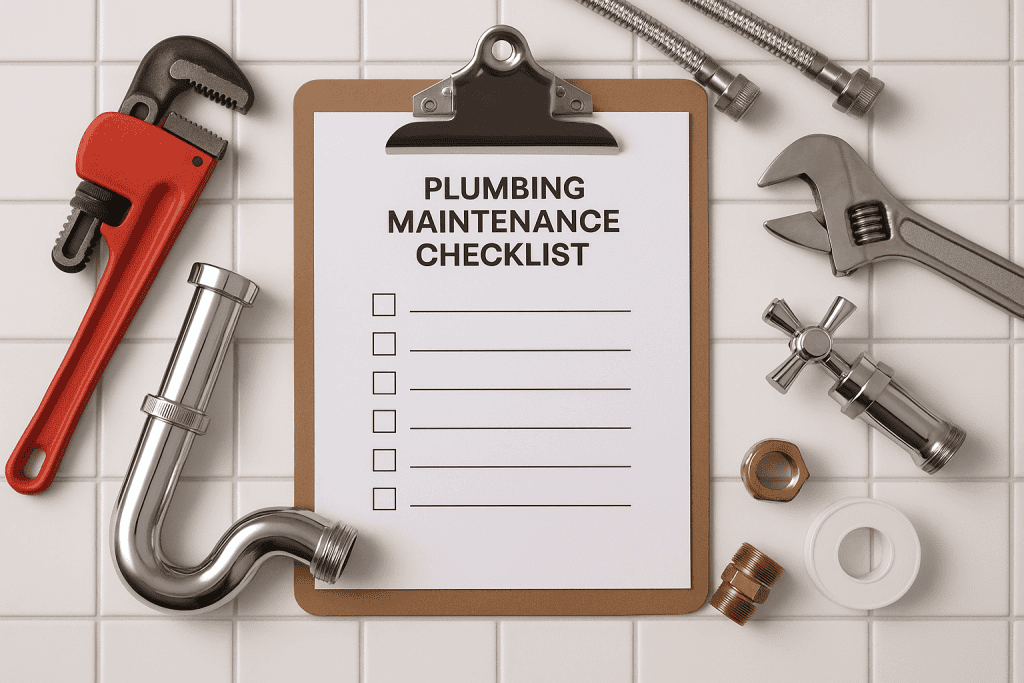
Plumbing Maintenance Checklist
Seasonal Plumbing Maintenance Checklist: Winter Freeze Protection and Outdoor Plumbing
Frozen pipes remain one of the costliest seasonal plumbing failures: the Association of British Insurers (ABI) has reported average escape-of-water claims of about £3,000, with severe incidents running far higher when ceilings and electrics become involved. The risk rises sharply when water expands on freezing, increasing internal pressure until copper or plastic splits at a weak point. A winter checklist focuses on keeping pipework above 0°C and reducing exposure to wind chill in unheated voids.
Before the first sustained cold spell, confirm that the internal stop tap turns fully and that every outdoor isolation valve operates without sticking. A 10–15 minute test now prevents a longer shut-down later, when a burst demands immediate isolation. Set heating controls to maintain a low background temperature during absences, because a drop from 18°C to single digits can occur overnight in poorly insulated properties. Pay close attention to pipe runs in lofts, garages, and under suspended floors, where insulation gaps often leave short “bridges” of exposed pipe.
Outdoor plumbing needs a separate check because it fails earlier than indoor pipework. Drain and isolate external taps, then leave the tap open to relieve residual pressure; a few hundred millilitres trapped in a hose can freeze and crack the bib tap body. Disconnect hoses and store them indoors, since a 10 m hose can hold several litres of water. If the property uses an outside supply for irrigation or a garden room, verify that the pipe has adequate lagging and that any trace heating functions correctly.
As temperatures rise in spring, inspect for delayed damage: hairline splits can leak only when pressure returns to normal. Run an outdoor tap for 60 seconds and check joints for weeping, then re-seat covers and insulation to prevent UV and weathering. For broader system context, review the Complete Guide to Boiler and Plumbing to align seasonal checks with heating and hot water controls.
When to Call a Plumber: Symptoms That Indicate Hidden Leaks or System Failure
At 06:30 on a Monday, a homeowner hears the boiler cycle twice within ten minutes, even though no one has used hot water. The bathroom floor feels slightly warm near the skirting, yet the radiator valves remain closed. By lunchtime, the water meter has advanced by roughly 30 litres without a single tap running, and a faint brown tide mark appears at the base of the airing-cupboard wall.
That pattern points to a hidden leak or a control fault, not “normal settling”. A continuous loss of 2 litres per minute can release 2,880 litres in 24 hours, enough to saturate chipboard flooring and wick into plaster. In the UK, escape-of-water damage often becomes expensive because the leak stays out of sight until moisture reaches a visible surface, by which time timber, insulation, and electrics may already be affected.
Call a plumber when symptoms suggest the system has moved beyond routine checks. Unexplained meter movement with all outlets off indicates a leak on the incoming main or within concealed pipework. A persistent drop in boiler pressure, such as falling from 1.5 bar to below 1.0 bar within a week, commonly signals a sealed-system loss that topping up will not solve. Repeated gurgling, slow drainage across multiple fixtures, or sewage odours can indicate a developing blockage or a failed trap seal that needs proper diagnosis.
Act quickly when you see staining, bubbling paint, warped skirting, or a musty smell that returns within 24–48 hours after drying. The U.S. EPA WaterSense estimates that households waste nearly 10,000 gallons (about 37,850 litres) each year from leaks, showing how small defects can run continuously. If you need a refresher on how boilers, valves, and pipework interact during faults, review the Complete Guide to Boiler and Plumbing before booking a visit.
Frequently Asked Questions
How often should you inspect visible pipework, taps, and fittings to prevent leaks?
Inspect visible pipework, taps, and fittings once a month for drips, corrosion, limescale, and damp patches. Check again after any plumbing work or temperature extremes, such as winter cold snaps. Replace worn washers and reseal joints promptly; a 1 mm continuous drip can waste about 11,000 litres of water per year.
Which early warning signs indicate a hidden water leak behind walls or under floors?
Hidden leaks often show as a water bill rising by 10–20% without higher use, persistent damp or musty odours, and peeling paint or bubbling plaster. Watch for discoloured patches, warped skirting boards, or lifting floor tiles. A water meter that moves when all taps and appliances are off also indicates a concealed leak.
What steps reduce the risk of blocked drains and slow-flowing sinks in kitchens and bathrooms?
Use drain strainers on sinks, showers, and baths, and empty them weekly. Scrape plates and bin food scraps; never pour fats, oils, or grease down the sink. Flush kitchen and bathroom drains with hot water weekly, and use enzyme cleaners monthly. Remove hair from plugholes fortnightly. Avoid flushing wipes, cotton buds, or sanitary products.
How can you check and maintain water pressure to protect pipes and appliances from damage?
Fit a pressure gauge to an outside tap and test with no water running; most homes run best at 1.5–3.0 bar. If pressure exceeds 4.0 bar, install or adjust a pressure-reducing valve. Clean tap aerators and showerheads every 3–6 months, and check the expansion vessel annually on sealed systems.
What plumbing tasks should you complete before winter to prevent frozen pipes and burst fittings?
Before winter, insulate exposed pipes in lofts, garages, and external walls, and fit foam covers to outdoor taps. Drain and isolate garden hoses and exterior pipework, and shut off outside stop valves where available. Seal draughts around pipe penetrations. Set heating to a minimum of 12–15°C, and locate the stopcock for emergencies.