
Slow drains often start with a small restriction that worsens over weeks, increasing the risk of odours, leaks, and water damage. Hair, grease, soap residue, and food waste account for a large share of domestic blockages, while tree roots and collapsed pipework can affect older properties. If water backs up in multiple fixtures, gurgling persists, or DIY methods fail after 24–48 hours, professional drain unblocking can restore flow and prevent repeat issues.
Key takeaways
- Slow drains usually start with grease, soap scum, hair, or food waste build-up.
- Gurgling sounds and bad odours often signal trapped air from a partial blockage.
- Multiple slow fixtures can indicate a deeper obstruction in the main drain line.
- Boiling water and a plunger can clear minor sink and shower blockages.
- A drain snake can remove hair clogs, but avoid forcing it past resistance.
- Call a plumber for recurring blockages, sewage smells, or water backing up.
Common Causes of Slow Drains in Kitchens, Bathrooms, and Outdoor Gullies
Water companies in England and Wales recorded 1.75 million sewer blockages in 2022–23, with fats, oils and grease (FOG) and wet wipes among the leading causes (Water UK). Slow drains often start as partial restrictions, where flow rate drops long before a pipe fully blocks. Identifying the likely source by location helps you choose the right fix and avoid forcing debris deeper into the system.
- Kitchens: FOG cools and hardens on pipe walls, then traps food particles. A 2–3 mm grease layer can narrow a 40 mm waste pipe by over 10%, reducing capacity during peak use.
- Bathrooms: Hair binds with soap scum and limescale, forming rope-like clogs in traps and bends. In hard-water areas, scale can build at roughly 1 mm per year on internal surfaces, accelerating slow drainage.
- Outdoor gullies: Leaves, silt and moss wash in during heavy rain, then settle in the gully pot. A 10–15 litre silt load can restrict the outlet and cause pooling near doors and patios.
If two or more fixtures drain slowly at the same time, the restriction often sits in a shared branch or the main drain rather than a single trap. For related maintenance checks across the property, see Complete Guide to Boiler and Plumbing.
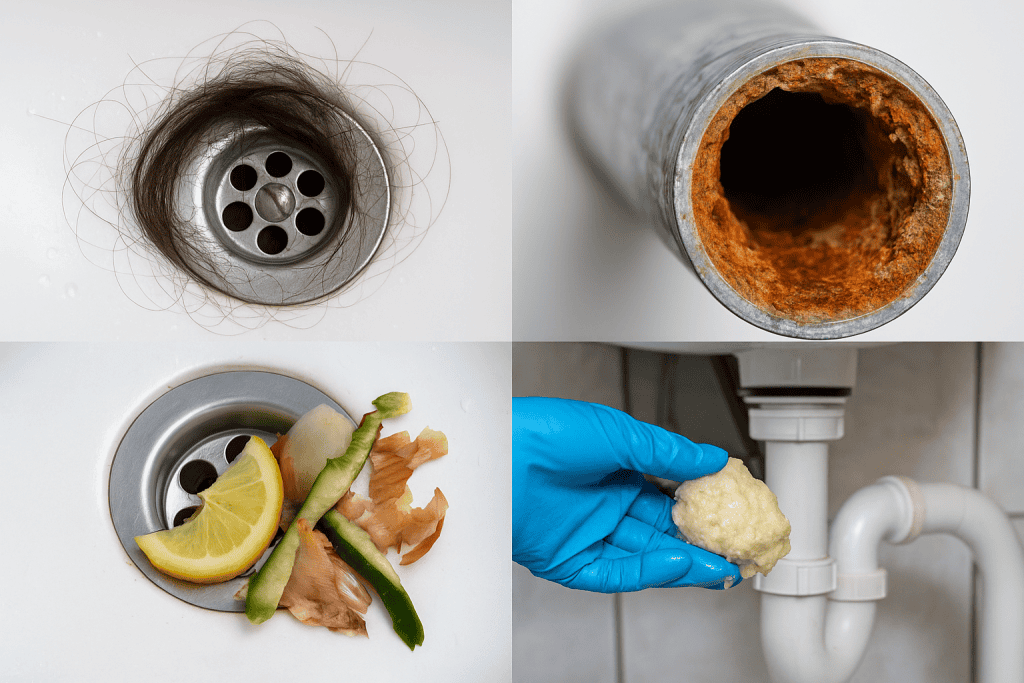
Causes of Slow Drains
How to Diagnose a Blockage: Warning Signs, Simple Tests, and What They Indicate
After a Sunday roast, a kitchen sink may start draining in 30–60 seconds instead of the usual 5–10, then gurgle as the bowl empties. That pattern often signals a partial blockage trapping air, not a failed tap or a “slow” waste by design. If the water level rises when a nearby appliance discharges, such as a dishwasher pumping out 10–15 litres per cycle, the restriction usually sits further along the shared branch.
Run a simple isolation test: fill the basin one-third, release the plug, then listen at the overflow and adjacent traps. A loud gulp points to poor venting caused by a developing obstruction, while repeated bubbling suggests back-pressure from a narrowing pipe. Check outdoor covers next; standing water in an inspection chamber indicates the blockage lies downstream. If two fixtures back up together or wastewater appears in a low-level gully, call a plumber promptly to prevent overflow and property damage.
Drain Unblocking Options: DIY Methods, Tools Used by Plumbers, and Typical Costs
DIY drain unblocking targets shallow, localised restrictions, while a plumber’s approach tackles deeper obstructions and checks for pipe defects. A £5–£15 plunger and a £10–£30 hand auger often clear hair or soap build-up within 1–2 metres of a trap, but these tools rarely shift compacted grease or scale in longer runs. Plumbers typically use motorised drain snakes (often 10–30 metres) and high-pressure water jetting, which can cut through grease and silt without leaving residues.
| Option | Typical tools | Best for | Typical UK cost |
|---|---|---|---|
| DIY | Plunger, hand auger | Single fixture, minor blockage | £5–£30 |
| Plumber | Motorised snake, jetting | Recurring or multi-fixture issues | £80–£250+ |
| Specialist | CCTV drain survey | Suspected collapse or root ingress | £150–£350 |
Choose DIY when only one sink slows and no odours or backflow appear. Call a plumber when two fixtures back up, the blockage returns within days, or outdoor gullies surcharge, since these signs often indicate a main line restriction where incorrect DIY can worsen flooding risk.
When to Call a Plumber: Emergency Red Flags, Compliance Risks, and Preventive Maintenance Plans
A slow drain becomes an emergency when wastewater backs up into a bath, shower, or gully within 10–30 seconds of running a tap, or when two fixtures overflow at the same time. Treat sewage odour lasting more than 24 hours, or staining around a manhole cover, as a high-risk sign of a main line restriction.
Call a plumber immediately if you suspect a compliance risk. In the United Kingdom, foul water must discharge to the correct system; misconnected appliances can breach Building Regulations Part H and increase pollution risk. If a blockage causes internal flooding, prompt isolation and safe clean-up reduces exposure to sewage pathogens.
- Emergency red flags: repeated backflow, water rising in a nearby fixture, or gurgling plus odour after every use.
- Structural warning signs: recurring blockages within 30–60 days, slow drainage across multiple rooms, or visible settlement near external drains.
- Safety triggers: electrical sockets near floodwater, or any overflow containing solids.
Ask the plumber to confirm the root cause, not only clear the line. A CCTV survey can locate defects within a few metres, while high-pressure jetting typically restores full bore flow in 30–90 minutes, depending on access and pipe length.
For prevention, set a maintenance plan: quarterly gully checks, annual jetting for high-use kitchens, and a grease-control routine that keeps FOG out of the waste. For broader system care, review Complete Guide to Boiler and Plumbing.
Frequently Asked Questions
What are the most common causes of slow drains in kitchens and bathrooms?
Kitchen drains most often slow due to grease and oil build-up, food scraps, and soap scum. Bathroom drains typically block from hair, soap residue, and limescale from hard water. In both rooms, mineral deposits can narrow pipework, and poor pipe gradient can reduce flow, causing frequent slow draining.
How can I tell whether a slow drain is caused by a local blockage or a main sewer line obstruction?
A local blockage usually affects one fixture, such as a single sink draining slowly, while other drains run normally. A main sewer line obstruction typically causes multiple fixtures to back up, often on the lowest floor, and may trigger gurgling sounds or sewage odours. If two or more drains fail within 24 hours, call a plumber.
Which drain unblocking methods are safe to try at home without damaging pipework?
Safe home methods include pouring boiling water down metal pipes (not PVC), using a plunger for 20–30 seconds, removing hair and debris from the plughole, and flushing with a mix of 1 cup bicarbonate of soda plus 1 cup white vinegar, then hot water after 15 minutes. Avoid caustic chemicals and drain snakes in fragile pipework.
When does a slow drain indicate a serious issue such as a collapsed pipe or tree root ingress?
A slow drain suggests a serious issue when multiple fixtures back up at once, blockages return within 24–72 hours after clearing, or gurgling and foul odours persist. Watch for sewage smells, damp patches, sinkholes, or sudden pooling outdoors. If drains slow after heavy rain or nearby trees, tree root ingress or a collapsed pipe becomes more likely.
How much does professional drain unblocking typically cost in the UK, and what factors affect the price?
Professional drain unblocking in the UK typically costs £80–£250 for a standard visit, while high-pressure jetting often ranges from £150–£400. Prices rise with call-out time (evenings can add 25–50%), blockage location (internal versus external), access issues, and whether CCTV drain surveying is required (£150–£300).
What should I expect during a professional drain inspection and unblocking visit, including CCTV surveying?
A plumber will ask about symptoms, then inspect accessible traps, gullies and manholes. A CCTV survey may follow, feeding a camera through the pipe to locate blockages, cracks or root ingress and measure depth and distance. Expect targeted unblocking using rodding, high-pressure water jetting or mechanical cutters, then a flow test and clear recommendations.